Building a really fast virtual filesystem for AI agents

AI agents like Codex or Claude Code are naturally extremely good at running bash commands. Searching through filesystems, grepping, getting context through the shell.
So I wanted to try: what if the entire filesystem an AI agent works on lived in Redis instead of on a disk? What if, to the AI agent, it looks like it's using any other filesystem, but actually it's a really fast in-memory store?
Here's how I wanted it to work 👇
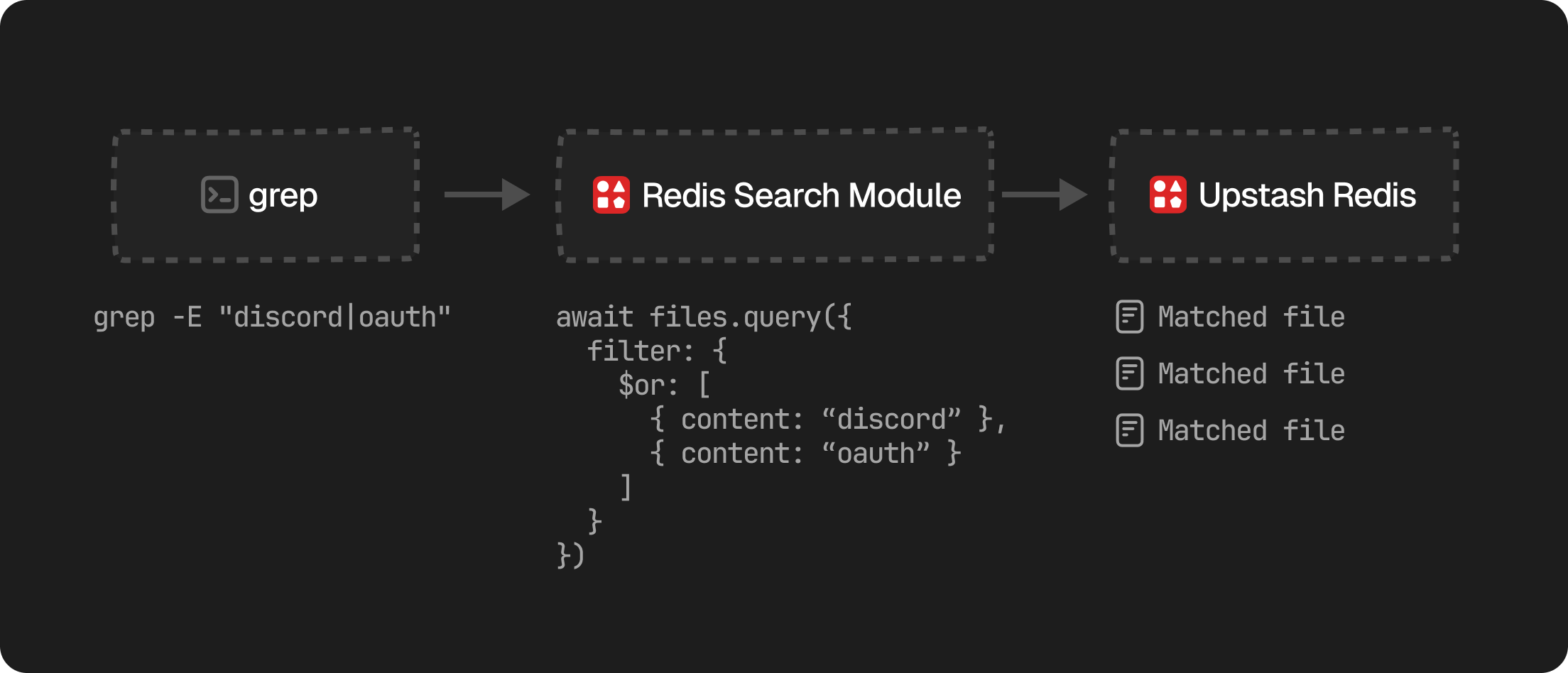
When the agent runs a grep command (which they are all exceptional at), we intercept it using Vercel's just-bash library and translate it to a Redis Search query.
That way, we wouldn't need any sandboxes for read-only access and (in theory) it should be much faster. And turns out Mintlify has already done something similar to this.
The idea
To see if this could work, I split the logic into three pieces
- Each file is a Redis JSON document. We store the path, content, size, timestamps, all together under one key.
- A manifest tracks the directory tree. One Redis key holds the entire folder structure so
lsandtreenever have to scan. - Redis Search for grepping. This way
grepdoesn't have to read every file to find a match.
And that's it! With these very few things in place, we can get very close to full parity of a regular (read-only) filesystem, but a lot faster. I decided against implementing writes for now.
The biggest challenge: grepping
Commands like cat or ls are pretty straightforward. We either read a single file in full or we list a directory structure, both of which are easy to do with Redis. Commands like sed -n '1,240p' are a bit more complicated, but we can absolutely make them work using Sorted Sets.
Grepping is a bit different. A normal grep -R "oauth" /workspace has to read every file under that directory. In a virtual filesystem that means pulling every document out of Redis just to check if it contains the word. That's really slow and expensive.
But we recently introduced Upstash Redis Search, a rust-based, extremely fast and efficient way to search through Redis data. With Redis Search, we can intercept grep before it runs, translate it to a query, and get fast results without fetching files.
A search query looks something like this:
import { Redis } from "@upstash/redis";

const redis = new Redis.fromEnv();
const index = redis.search.index({ name: "vfs" });

const matches = await index.query({
  filter: {
    $must: [
      { workspaceId: "demo" },
      { kind: "file" },
      { content: { $phrase: "oauth" } },
    ],
  },
  select: { path: true },
});
The agent still sees the same output it would from a normal shell.
Giving an agent a shell
The last piece is wiring this up to just-bash so an agent can run commands against it. Inspired by how Mintlify built their assistant's filesystem, we mount a Redis-backed fs adapter at /workspace on a MountableFs:
import { InMemoryFs, MountableFs } from "just-bash";

const mountableFs = new MountableFs({ base: new InMemoryFs() });
mountableFs.mount("/workspace", redisFs); // redisFs talks to Upstash

const bash = new Bash({ fs: mountableFs, cwd: "/workspace" });
When the agent runs cat /workspace/src/index.ts, that readFile call goes straight through to Redis. grep is intercepted and redirected to Redis Search.
From the agent's perspective it's just a shell. ls, cat, grep, find, all of it works. When we put that into the Vercel AI SDK as a bash tool, we have an agent that can explore a codebase that lives entirely in Redis.
How I got the idea
For one, the great article from Mintlify I linked above. And second, most agent sandboxes are heavy. We boot a container, mount a disk, and pay the cost of all that whether the agent touches one file or a thousand.
A virtual filesystem with Redis is always on, globally replicated, durable, and the most expensive operation (searching across files) is the one Redis Search is great at.
Cheers 🙌 Josh
https://upstash.com/start-redis - no signup required.Upstash runs Redis as a serverless database - create one in seconds and pay only per request. Explore Upstash Redis →